Exactly one month ago, on November 2, the liturgical calendar celebrated All Souls’ Day. Recurring annually, this is a day to remember all of the faithful who have died. It follows All Saints’ Day (November 1), which is when the Church annually celebrates all the saints and martyrs throughout Christian history.
My mother died six years ago on All Souls’ Day. She died of progressive aphasia. Aphasia is a memory-loss disease (like Alzheimer’s) that begins in the language processing parts of the brain. My mother first lost words, then sentences. Eventually, she lost the ability to read, write, and speak. At the end, aphasia becomes what you expect from a diagnosis of Alzheimer’s disease. She lost the rest of her memory and cognition, too.
It was heart-wrenching to watch her walk through the stages of language and memory loss. My mother was a New Testament Greek professor. She loved language and she especially loved Greek. She thrived on words!
At first, she fought to retain every single word she could in both Greek and in English. I have journals where she wrote the names of people she loved, and Greek words that mattered to her in long lists. Early in her disease, she copied whole passages from the New Testament, fighting to retain those words. Over time, the lists became shorter. The Greek words and alphabet letters disappeared completely. In the end, she lost most of her ability to communicate.
But she left behind a trail of words, sentences, and conversations that shine brightly. She didn’t leave me wondering what was important to her. I have her files, her notes, her prayer journals, her books. Her lists.
Her copy of Interior Castles by St. Teresa of Ávila is held together with a rubber band. On every page, she penciled in her thoughts. One set of notes is tucked into the front of the book. A piece of paper torn out of a spiral notebook with her teaching outline is tucked into the back of the book.
In the middle of her files for her Greek classes, I found a folder with a heart penciled in on the top. Inside is a collection of letters and pictures and photographs from each of her children and grandchildren. She placed it where she would run across it as she prepared for class. She kept what was important to her in plain sight.
Mom communicated what mattered. She didn’t leave things undone. She told me she loved me. She would say, “I’m sorry.” She laughed with us and she cried with us. She made up stories that caused my children to dissolve in giggles when they were young — “Beauregard the tickle bug” who lived in her hair was a particular favorite. She was never short on words that brought hope into hard conversations.
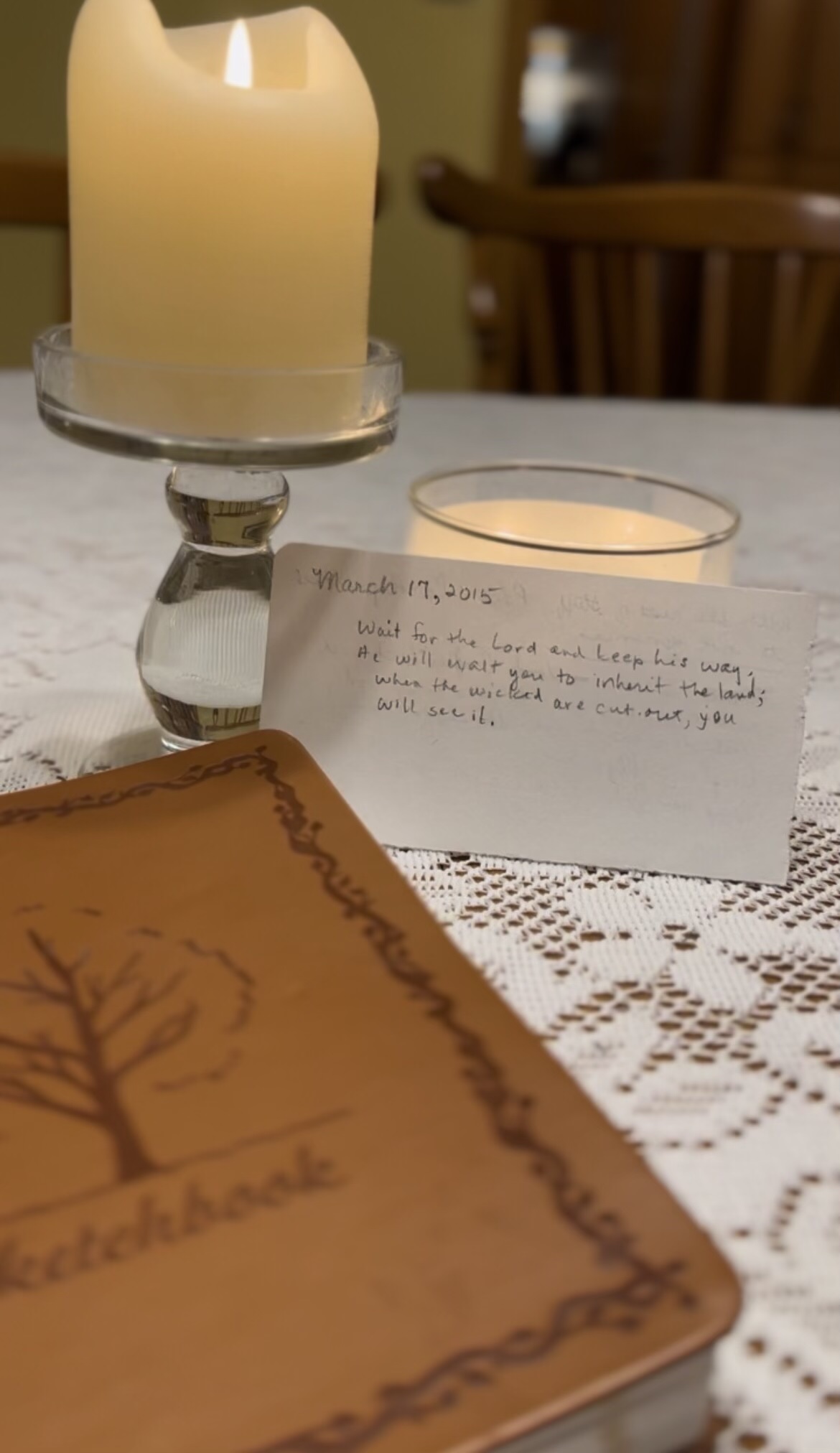
Just last week, I opened a nearly blank journal of hers, and out tumbled a hand-written bible verse she had written out and tucked inside. I am still finding my mom’s words.
Mom kept a tea shelf in her kitchen cabinet. When I came home, there was always blueberry tea. We would make ourselves a cup and sit on the stoop beside the kitchen in the sunshine and chat. In my memory, time paused when we wrapped our hands around cups of blueberry tea, laughing and catching up with each other.
So, on All Souls’ Day, I made myself a cup of blueberry tea and sat in the sunshine and remembered my mother. I’m grateful that she didn’t leave anything unsaid. I’m grateful the words she loved took root in her heart. I’m grateful for the return of All Soul’s Day each year, reminding me that my mother is not lost and death is not the final word.
What trail of words are you leaving behind you? What do you want to be sure gets said?